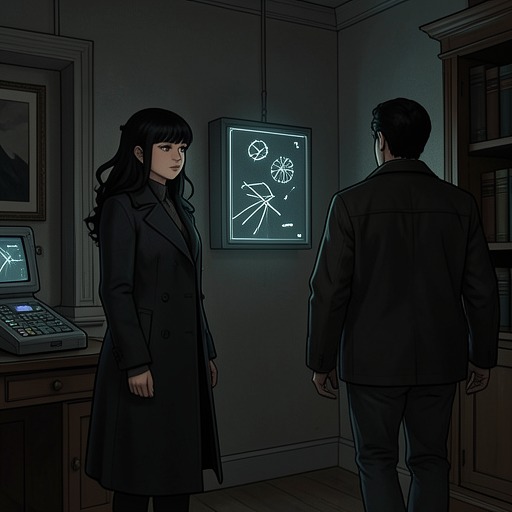
Joe Mulligan's apartment
The Stars Have EyesJoe Mulligan's apartment is the intimate material center of Joe Mulligan’s life: a tiny government-provided room suspended high above a mega-city, dominated by a Full Immersion Pod 3,000™ and repeatedly transformed by Joe’s relationship with Maggie. Its cramped dimensions and almost total dependence on technology make it both a shelter and a symbol of a society in which ordinary citizens possess security without meaningful employment, autonomy, or physical independence.
Physical Setting and Provision
Joe’s apartment occupies the sixty-sixth level of the hyper-scraper, above the suspended streets around the fiftieth level. It measures approximately five meters wide, four meters long, and two and a half meters tall. The room contains almost nothing besides a bulky pod-like machine whose off-white metal is marked by scrapes, bumps, and stains. Its sliding glass door hisses angrily whenever it opens or closes, giving the supposedly indispensable device an unmistakably worn and material presence.
The only other decoration specifically noted is a picture of Mechalizabeth II, Eternal God-Queen of the 3rd British Empire, hanging on the wall. Joe must wave at the image at least once every twenty-four hours to retain his state benefits. Those benefits consist of the apartment, a monthly allowance, and the Full Immersion Pod 3,000™. The arrangement is sparse but not exceptional: in this society, fewer than 0.1 percent of citizens enjoy employment, and steady work is treated as a mark of prestige. Joe’s home therefore embodies the normal condition of the unemployed majority rather than an unusual personal failure.
The Pod and Technological Dependence
The apartment’s pod is not merely furniture. Joe uses it to survive his daily life, explaining that he simply plugs into it when Maggie asks how he manages in such restricted surroundings. Humanity’s dependence on machines has become so extensive that Joe worries he would not know how to feed, clothe, or bathe himself if the device were destroyed. The pod provides convenience, entertainment, and practical assistance, but that convenience has also displaced ordinary self-sufficiency.
Maggie makes the apartment’s central object newly visible by treating it as something to investigate rather than an unquestioned part of Joe’s routine. While Joe waits outside, she negotiates with the pod, and the room fills with alarming noises, including metallic clangs and stranger sounds that Joe cannot identify. He becomes concerned not only because Maggie might damage the machine, but because replacing it could take anywhere from a day to a week. The apartment thus becomes a place where technological comfort and technological vulnerability are inseparable.
Maggie later claims confidence in the upgrades she has made to the device. When Joe enters, the pod’s glass door opens automatically, and its mechanical arms fasten a small plastic collar with blinking lights around his neck. A newly altered, fleshy support presses against his lower back, initially resembling an orthopedic cushion. The machine’s normal function is consequently overlaid with Maggie’s intervention, making the pod a physical extension of their bond as well as a state-issued appliance.
Relationship Space and Social Exchange
The apartment becomes the first fully private setting in which Joe and Maggie negotiate what their relationship means. Joe offers himself as Maggie’s guide and anchor in reality, while Maggie promises to bind herself to him, guard and nurture his fragile being, and study the world through him. Their exchange is simultaneously emotional, contractual, and practical: protection is offered in return for access, guidance, and an anchor in the physical world.
The pod intensifies that intimacy because it can technically accommodate two people, although only in a very tight fit. Maggie climbs inside with Joe and presses her chest against his, turning the cramped machine into an enclosed space of physical closeness. The apartment therefore shifts from an impersonal state habitat into a private theater for attachment, experimentation, and mutual adjustment. Within it, Maggie studies Joe’s bodily and expressive habits, including his breathing, blinking, walking, and facial expressions, while Joe attempts to teach her the ordinary social meanings of human behavior.
The room also supports more instrumental forms of exchange. A visitor whose business premises remain in disarray offers Maggie one of his pets if she helps establish a customer base. Elsewhere, Oliver Millington proposes placing Maggie in contact with a cybersecurity division and offering a monthly stipend of three thousand poundingtons for her assistance, a sum equal to sixty of Joe’s usual allowances. Although the apartment is not the site of every negotiation, it functions as the domestic point from which Maggie’s abilities become economically and institutionally visible.
Threat, Absence, and Domestic Performance
Joe’s doorway marks a shifting boundary between private life and public scrutiny. During one investigation, his door suddenly opens and Joe pokes his head out, greeting an officer who has been speaking with others nearby. The brief interruption exposes how little separation exists between Joe’s domestic world and the authorities or visitors moving through it. The apartment can shelter him, but it cannot fully conceal the extraordinary presence associated with him.
After Maggie’s absence, the same space becomes emotionally distorted. Joe continues to look after Maggie’s vessel and participates in a domestic routine that imitates her presence, but the performance cannot reproduce the person he misses. At breakfast, the ordinary furnishings and prepared food offer no real consolation; Joe’s joking facade collapses as he longs for Maggie’s genuine smile and speech rather than monotonous replies. The apartment becomes a transitional space between companionship and bereavement, preserving habits whose emotional center has disappeared.
That absence also forces Joe to reconsider the meaning of dependence. His father warns him not to let Maggie become his entire world and urges him to become his own man instead of allowing others to guide him. Joe’s apartment, once a place where he passively plugs into technology and receives care, becomes the setting from which he prepares to take control of his life. His decision is not presented as a rejection of Maggie, but as an attempt to act rather than remain entirely defined by waiting for her return.
Ritual and Narrative Significance
The apartment’s significance culminates in Joe’s desperate effort to reverse Maggie’s absence. He revives the Cult of the Gazing Star and reconstructs the ritual that originally summoned Magh'rathlak the Observer into reality. Maggie’s vessel helps transfer the entity’s notes, recordings, and comments into digital form, allowing Joe to learn the ceremony’s exact requirements, including the annual planetary alignment, chants, props, and devices. The domestic space and its technology thus become part of a chain leading outward from private grief to occult action.
The apartment is important precisely because it is so unimpressive. Its narrow walls, damaged pod, allowance, ceremonial portrait, and dependence on state technology compress the major tensions surrounding Joe: comfort against autonomy, care against control, virtual immersion against physical reality, and ordinary domestic life against cosmic danger. It is where an unemployed citizen survives, where an eldritch relationship becomes intimate, where a machine’s material limits suddenly matter, and where Joe gathers enough resolve to pursue Maggie beyond the boundaries of ordinary life.